
Options trading is an exciting financial endeavor, offering limitless strategies to suit various risk appetites and market outlooks. Among these strategies, the Short Strangle Option Strategy stands out for its potential to generate consistent income. In this blog, we will explore the mechanics of the short strangle, its advantages and risks, and how modern options trading tools like K-Trader can enhance your trading experience, especially in the Indian stock market.
Table of Contents
What is Short Strangle Option Strategy
The short strangle is an options strategy where a trader simultaneously sells an out-of-the-money (OTM) call and an OTM put option on the same underlying asset and expiration date. By selling these options, the trader collects premiums, aiming to profit if the underlying asset remains within a specific price range until expiration.
In the Indian context, this strategy is commonly applied to indices like Nifty 50 or Bank Nifty, which are highly liquid and have well-established options markets. The short strangle is most effective in markets with low volatility, where significant price swings are unlikely. The collected premiums provide a cushion against minor price movements, making the short strangle a popular choice among seasoned traders.
How Does the Short Strangle Work?
Select Strike Prices: Choose a call option and a put option with strike prices above and below the current market price, respectively. For instance, if Nifty 50 is trading at 23,500, you might sell a 24,000 call and an 23,000 put.
Sell the Options: Decide quantities as per risk management plan and sell both the options
Monitor the Trade: As expiration approaches, the goal is for Nifty’s price to remain between the two strike prices, allowing both options to expire worthless. This ensures the trader retains the full premium as profit.
Manage Risks: If Nifty’s price moves significantly, be prepared to adjust or close the position to mitigate losses.
Pros and Cons of the Short Strangle Option Strategy
Advantages:
Premium Income: The strategy generates upfront income through collected premiums.
Flexibility: It can be tailored to different risk levels by adjusting the strike prices.
Non-Directional: Suitable for traders who expect low volatility rather than a specific price movement.
Risks:
Unlimited Loss Potential: Large price movements can lead to significant losses.
Margin Requirements: Brokers may require substantial margin due to the strategy’s risk profile. With SEBI’s new rules, margin requirements have significantly increased on expiry days, thus lowering the ROI.
Time Decay Dependency: Profitability heavily relies on time decay and stable market conditions.
- Sudden Fast Movements in underlaying: There could be significant losses in this strategy incase of sudden market movements. Hence timely adjustments or exit is really important for risk management
Example of a Short Strangle Option Strategy in the Indian Stock Market
Let’s consider an example using Nifty 50:
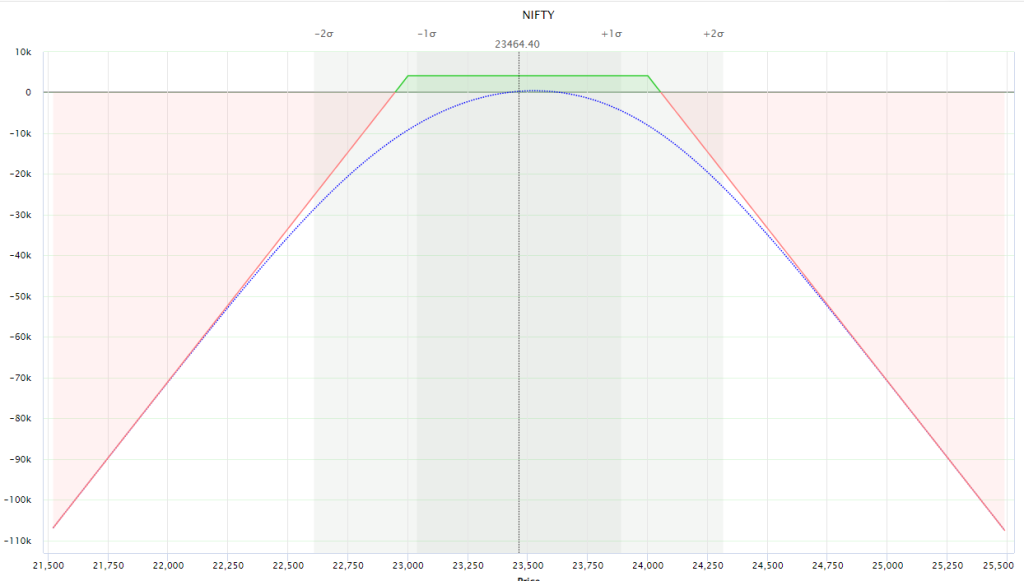
Nifty 50 is trading at 23,500.
You sell a 24,000 weekly call option for a premium of ₹25.
You sell an 23,000 weekly put option for a premium of ₹30.
Total premium collected: ₹55.
If Nifty remains between 23,000 and 24,000 by expiration, both options expire worthless, and you retain the ₹55 as profit. However, if Nifty moves outside this range, the losses can escalate depending on the magnitude of the move.
Payoff Chart of Short Strangle Strategy
Adjustments in Case of Market Movements
Market movements can pose a significant risk to a short strangle strategy. Here are some common adjustments to manage such situations:
Roll the Strikes:
Move the call and put strike prices further away from the current market price to reduce the risk of large losses. This might involve closing the existing positions and opening new ones at different strikes.
Hedge with Long Options:
Buy an OTM call or put option to cap the potential loss on the unhedged side of the strangle. For instance, if Nifty moves sharply upwards, purchasing a higher strike call option can mitigate the risk.
Close One Leg:
If the market moves closer to one of the strikes, consider closing that position while retaining the other leg. This helps limit losses on the threatened side while allowing potential gains from the remaining leg.
Convert to a Straddle:
If the market becomes highly volatile, you might adjust to a straddle by selling options closer to the at-the-money (ATM) level. This requires careful monitoring and analysis.
Reduce Position Size:
When volatility spikes unexpectedly, reducing the position size can help manage margin requirements and lower overall risk.
Use Stop-Loss Orders:
Predefine stop-loss levels for both the call and put options to exit the trade if the market moves beyond a specific threshold.
Why Use Options Trading Tools for Short Strangle?
Executing and managing a short strangle requires precision, timely analysis, and robust risk management. especially while trading intraday. Modern options trading tools like K-Trader streamline this process by offering features such as:
Real-Time Market Data: Stay updated with accurate pricing and P&L metrics for Nifty and Bank Nifty options.
Seamless Execution: Place trades efficiently through an intuitive options trading platform. Which enables you to place multi leg entries in single click
Advanced Analytics: Evaluate potential outcomes and adjust positions with confidence.
Risk Management Features: Set stop-loss for a let or set strategy level stop loss or targets, adjust stop loss and targets as per market movement on the fly to control risks effectively.
Tips for Success with Short Strangle
Analyze Volatility: Opt for this strategy in low-volatility markets where significant price movements are unlikely.
Set Realistic Targets: Ensure the premiums collected justify the potential risks.
Utilize Tools: Leverage advanced platforms like K-Trader Options Trading Tool for precise execution, monitoring and risk management
Stay Disciplined: Establish clear exit strategies and adhere to them
Risk Management: Ensure proper rules are setup and followed during the trading to avoid big losses. e.g. percentage of total capital as stop loss or certain amount on each sold leg as stop loss, percentage movement as target etc.
Conclusion
The short strangle options strategy offers an attractive avenue for traders seeking consistent premium income. However, its success hinges on careful planning, effective execution, and diligent risk management. Equipping yourself with cutting-edge options trading tools can significantly enhance your trading journey, helping you execute strategies with precision and confidence.
Ready to elevate your options trading game? Explore K-Trader Options Trading Tool today and unlock the potential of smart, efficient trading in the Indian stock market!